









 |


Sleep and Chronobiology Research Lab
The EP Bradley Hospital Sleep and Chronobiology Research Lab was established in 1985 and remains part of EP Bradley Hospital, a Brown University Health Partner affiliated with the Alpert Medical School of Brown University. The laboratory building, located on the campus of Butler Hospital at 300 Duncan Drive on Providence’s East Side, is a free-standing facility containing a 4-bedroom laboratory, offices, testing areas, storage space, and kitchen facilities. The research lab also includes an annex with classroom and additional research space, including a biospecimen lab for DNA extraction, normalization, quantification, and RTPCR, as well as ELISA assays. The founding laboratory director and director of the Bradley Hospital COBRE Center for Sleep and Circadian Rhythms in Child and Adolescent Mental Health is Mary A. Carskadon, PhD, Professor, Department of Psychiatry and Human Behavior, Alpert Medical School of Brown University. Other academic leaders in the laboratory include Associate Director and Associate Professor Jared Saletin, PhD, Associate Professor Dave Barker, PhD, Assistant Professor Darlynn Rojo-Wissar, PhD, and postdoctoral fellows Gina Mason, PhD, Kathleen Horan, PhD, and Lindsay Stager, PhD. Faculty affiliated with Bradley Hospital's COBRE Center for Sleep and Circadian Rhythms in Child and Adolescent Mental Health include Jennifer Freeman, PhD, Jennifer Wolff, PhD, John McGeary, PhD and Christopher Houck, PhD, and Center-funded investigators include research project leaders Sarah Thomas, PhD, Anastacia Kudinova, PhD, Marie-Rachelle Narcisse, PhD, and Giulia Righi, PhD, and pilot project leaders Grace Cushman, PhD and Petya Radoeva, MD. Additional affiliated faculty of the COBRE Center include: Diana Grigsby-Toussaint, PhD (COBRE Center graduate), Thomas F. Anders, MD, Larry K. Brown, MD, Daphne Koinis Mitchell, PhD, Sharon I. Rounds, MD, Henry T. Sachs, MD, Anthony Spirito, PhD, and Diane Lipscombe, PhD. We also routinely work with faculty from Brown University, Alpert Medical School of Brown University and/or other universities including: Rachel Herz, PhD, Boston College; Leila Tarokh, PhD, Bern University; Hollie Raynor, PhD, University of Tennessee Knoxville, and Chantelle Hart, PhD. Temple University. Core members of the research team at the lab include: data coordinator, Caroline Gredvig-Ardito; COBRE Center Research Administrative Coordinator, Cristal L. Medeiros; administrative assistant, Christine Hawkinson; and research assistants and laboratory techs: Chloe Lambert, Shreya Varrier, Sinead Moyles, Claire Mayew-Sherman, Luna Sato, Aashri Sadu, Grace Kupka, Kiara Medeiros, Katie Skordinski, Jayne Clark, Gretchen Morris, Kelly McCormick, Sophia Nicogossian, and Orli Juarez. (It’s worth noting that several of the research assistants and laboratory techs were first introduced to the Sleep Lab through the Summer Apprenticeship program!) Program of Research
Research projects in the lab focus on examining sleep patterns, circadian rhythms, and related processes and outcomes in children, adolescents, and adults. Sleep patterns in humans depend upon the complex interplay of distinct extrinsic and intrinsic factors. Research in our laboratory reflects a longstanding interest in the fundamental organization of sleeping and waking patterns in humans. Our group currently has a broad program of research, including (1) PBBS, Parent Brain, Behavior and Sleep Study, led by Dr. Mason, examines the sleep of birthing parents and their 5- to 6-month-old infants using week-long actigraphy/report, parent mental health, brain function (fMRI), and parenting behavior/infant development; (2) Sleep & LEARN, a project examining the impact of sleep restriction on learning and brain function in children (led by Dr. Saletin); methods include actigraphy, neurobehavioral tasks, fMRI, and circadian phase assessment; (3) CPS-MTEC, a project implementing targeted lighting prescriptions to alter circadian phase and evaluating new wearable technology for assessing sleep and circadian phase (led by Dr. Carskadon); (4) CPS-NOAA, a project led by Dr. Carskadon to evaluate sleep, circadian timing and phase shifts, fatigue, and performance in crew members on NOAA vessels with Circadian Positioning Systems lighting installed; (5) SCOUT, a project led by Dr. Carskadon in partnership with RIH (Drs. Rich, Park, and Ramsey) and the VA (Drs. McGeary and Benca-Bachman) and in collaboration with labs at the University of Pittsburgh, Johns Hopkins University, the University of Alabama Birmingham, and Harvard University that focuses on determining how craving and emotion regulation, sleep, and circadian rhythms affect people who are receiving medical treatment for Opioid Use Disorder; (6) Oral Microbiome & Sleep, Dr. Marie-Rachelle Narcisse’s research exploring the interplay between oral microbiome, sleep, circadian rhythms, and depression among adolescents and young adults with secondary data analysis of nationwide data sets. Our program’s major projects enable us to examine these issues with experimental paradigms involving manipulating sleep and with studies that evaluate sleep/wake and circadian processes at fundamental mechanistic levels. back to top Recent and Relevant References
Carskadon, M.A., Chappell, K.R., Barker, D.H., Hart, A.C., Dwyer, K., Gredvig-Ardito, C., and McGeary, J.E. A pilot prospective study of sleep patterns and DNA methylation-characterized epigenetic aging in young adults. BMC Research Notes 12:583, 2019. https://doi.org/10.1186/s13104-019-4633-1 PMID: 31526398 Link here! Tarokh, L., Short, M., Crowley, S.J., Fontanellaz-Castiglione, C., and Carskadon, M.A. Sleep and circadian rhythms in adolescence. Curr. Sleep Med. Reports, 2019. https://doi.org/10.1007/s40675-019- 00155-w Link here! Barker, D.H., Carskadon, M.A., Gredvig-Ardito, C.N., Hart, C.N., Raynor, H., and Scheer, F.A.J.L. Independent effects of the human circadian system and sleep/eating cycles on caloric intake in adolescents vary by weight status. PNAS 122 (8) e2407907122, 2025. doi.org/10.1073/pnas.2407907122 Barker & Carskadon shared 1st authorship. PMID: 39964717 Meltzer, L.J., Saletin, J.M., Honaker, S.M., Owens, J.A., Seixas, A., Wong, P., Wolfson, A.R., Wahlstron, K.L., and Carskadon, M.A. COVID-19 instructional approaches (in-person, online, hybrid), school start times, and sleep in over 5000 US adolescents. Sleep 269(1):, 2021. doi: 10.1093/sleep/zsab180. PMID: 34401922 Link here! Klerman, E.B., Brager. A., Carskadon, M.A., Depner, C.M., Foster, R., Goel, N., Harrington, M., Holloway, P., Knauert, M.P., LeBourgeois, M.K., Lipton, J., Merrow, M., Montagnese, S., Ning, M., Ray, D., Scheer, F.A.J.L., Shea, S.A., Skene, D.J., Spies, C., Staels, B., St-Onge, M-P., Tiedt, S., Zee, P.C., and Burgess, H.J. Keeping an eye on circadian time in clinical research and medicine. Clin Translat Med 2022; Dec;12(12):e1131. doi: 10.1002/ctm2.1131.PMID: 36567263 Link here! Reynolds, A., Spaeth, A., Hale, L., Williamson, A., LeBourgeois, M., Wong, S., Hartstein, L., Levenson, J., Kwon, M., Hart, C., Greer, A., Richardson, C., Gradisar, M., Clementi, M., Simon, S., Reuter-Yuill, L., Picchietti, D., Wild, S., Tarokh, L., Sexton-Radek, K., Puzino, K., Calhoun, S., Johnson, D., Lewin, D., and Carskadon, M. Pediatric sleep: Current knowledge, gaps, and opportunities for the future. Sleep. 2023 Mar 6:zsad060. doi: 10.1093/sleep/zsad060. Online ahead of print. PMID: 36881684 Link here! Wong, P., Wolfson, A.R., Honaker, S.M., Owens, J.A., Wahlstrom, K.L., Saletin, J.M., Seixas, A., Meltzer, L.J., and Carskadon, M.A. Adolescent social jetlag, sleep opportunity, and mental health in the context of varied educational approaches: Findings from a large nationwide study during COVID-19. Sleep Health, in press. Link here! McCullar, K. S., Barker, D. H., McGeary, J. E., Saletin, J. M., Gredvig-Ardito, C., Swift, R. M., & Carskadon, M. A. (2024). Altered sleep architecture following consecutive nights of presleep alcohol. Sleep, 47(4), zsae003. https://doi.org/10.1093/sleep/zsae003. PMID: 38205895 Link here! Rojo-Wissar, D. M., Parade, S. H., Barker, D. H., Van Reen, E., Sharkey, K. M., Gredvig-Ardito, C., & Carskadon, M. A. (2024). Does sleep link child maltreatment to depressive symptoms among incoming first-year college students? In press, SLEEP Advances June 12, 2024. https://doi.org/10.1093/sleepadvances/zpae041 Link here! Saletin, J. M., Wolfson, A. R., Wahlstrom, K. L., Honaker, S. M., Owens, J. A., Seixas, A. A., Wong, P., Carskadon, M. A., & Meltzer, L. J. (2024). Instructional approach, sleep, and perceived academic well-being in adolescents during COVID-19: Evidence from the NESTED study. In press, Sleep Health, 04/07/24. https://doi.org/10.1016/j.sleh.2024.04.006. Link here! back to top 
Commitment full time 25 May 2026 through 19 August 2026
back to top 
What Research Apprentices Learn: Formal Training Program
back to top 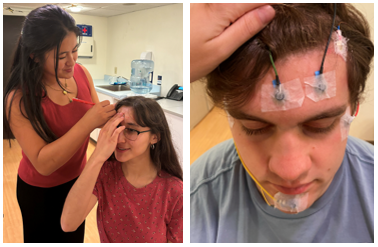
What Summer Research Fellows Do
Our lab is involved with several projects that research apprentices may work on throughout the summer as outlined above. Several of these projects include laboratory assessments that necessitate apprentice involvement around the clock (i.e., day AND night) Research apprentices carry out multiple facets of data collection (electrode application, working one-on-one with research participants for forms/tests administration), data reduction, data entry, and data error checking. During the in-lab research phases of the program, apprentices are assigned to teams and work 4 to 6 days each week—not always Monday through Friday, often Saturday and Sunday—in research protocols that often involve working unusual schedules. Applicants must be able and willing to work on various types of schedules for all or part of the program. [Sleep planning assistance (e.g., earplugs, eye masks, and light boxes) is provided to help you adapt to work schedules; sample schedules are available on request.] When possible, we attempt to assign apprentices to hours that correspond to their circadian phase preferences, as well as make an effort to keep schedules somewhat consistent. back to top 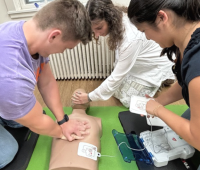
Eligibility
Undergraduate students with strong interest in behavioral sciences research and who demonstrate enthusiasm for, commitment to, and availability for the full program are encouraged to apply. We also encourage seniors or recent graduates to apply with potential for full-time Research Assistant positions in Sleep Lab or COBRE center projects after the summer. Previous courses or lab work in sleep or circadian rhythms are helpful but not required. During the apprenticeship, fellows will be required to reside in or very near Providence. Members of underrepresented minorities and individuals from disadvantaged backgrounds are encouraged to apply. Due to restrictions on funding sources, we are only able to accept US citizens, noncitizen nationals of the United States or those who have been lawfully admitted for permanent residence in the US. back to top Application
Complete the application form and submit it by February 16, 2026. Have 2 letters of recommendation (preferably from professors) e-mailed directly to Dr. Carskadon and Christine Hawkinson (see addresses on the application form) by the same deadline. A member of the admissions committee will interview the short list of candidates via Zoom or in person. 2026 Summer Apprenticeship Application back to top 
Benefits
back to top Retreat Programs
The summer's end retreat includes assorted activities and events. Central to the retreat, however, is the program of presentations by summer interns. These presentations are unfailingly awesome and highlight the breadth of sleep research and the apprentices' interests. Another major component of the retreat comes from our visiting investigators, often young investigators with a mix of seasoned scientists for good measure. Donors who support the program are welcome to join us for this exciting event. Check out the 2025 Program! 2001 Retreat Program 2002 Retreat Program 2003 Retreat Program 2004 Retreat Program 2005 Retreat Program 2006 Retreat Program 2008 Retreat Program 2009 Retreat Program 2010 Retreat Program 2011 Retreat Program 2012 Retreat Program 2013 Retreat Program 2014 Retreat Program 2015 Retreat Program 2016 Retreat Program 2017 Retreat Program 2018 Retreat Program 2019 Retreat Program 2021 Retreat Program 2022 Retreat Program 2023 Retreat Program 2024 Retreat Program 2025 Retreat Program back to top |
